Why You Need a Personal Mission Statement
Most of us stay busy without asking why. Stephen Covey calls this out in Habit 2 of The 7 Habits of Highly Effective People: Begin with the End in Mind. His answer to it is a personal mission statement.
What It Is
A personal mission statement is a written declaration of your core values, your purpose, and the kind of person you’ve decided to be. Not a goal list. Not a vision board. Think of it as a personal constitution — the document you return to when a hard decision lands, or when life knocks you sideways and you need to find your footing again.
It doesn’t ask what you want to achieve. It asks who you want to become.
Two very different questions.
Why It Matters
Without a defined center, most people default to one of two modes: reacting to whatever feels urgent, or performing for whoever is watching.
Covey puts it plainly:
It's incredibly easy to get caught up in an activity trap, in the busyness of life, to work harder and harder at climbing the ladder of success only to discover it's leaning against the wrong wall.
A mission statement gives you a compass — not just a map. Maps tell you how to get somewhere; a compass tells you which direction actually matters to you.
How to Write One
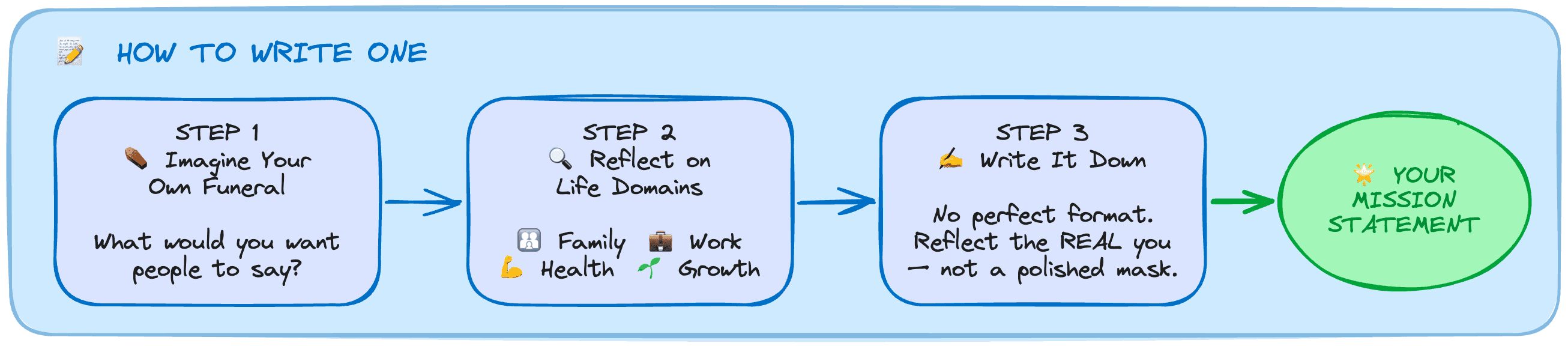
Covey suggests starting with a thought experiment: imagine your own funeral. What would you want people to say about you — as a partner, a colleague, a friend? The life you’d want eulogized is the life your mission statement should point toward.
There’s no perfect format. Some are a single sentence. Others are structured by life domain — family, work, health, personal growth. What matters is that it reflects you — not a polished version of who you think you should be.
A Real Example
Here is my personal mission statement — seven commitments, each specific and actionable.